When Someone Searches “Car Accident Lawyer Near Me,” They’re Ready to Call
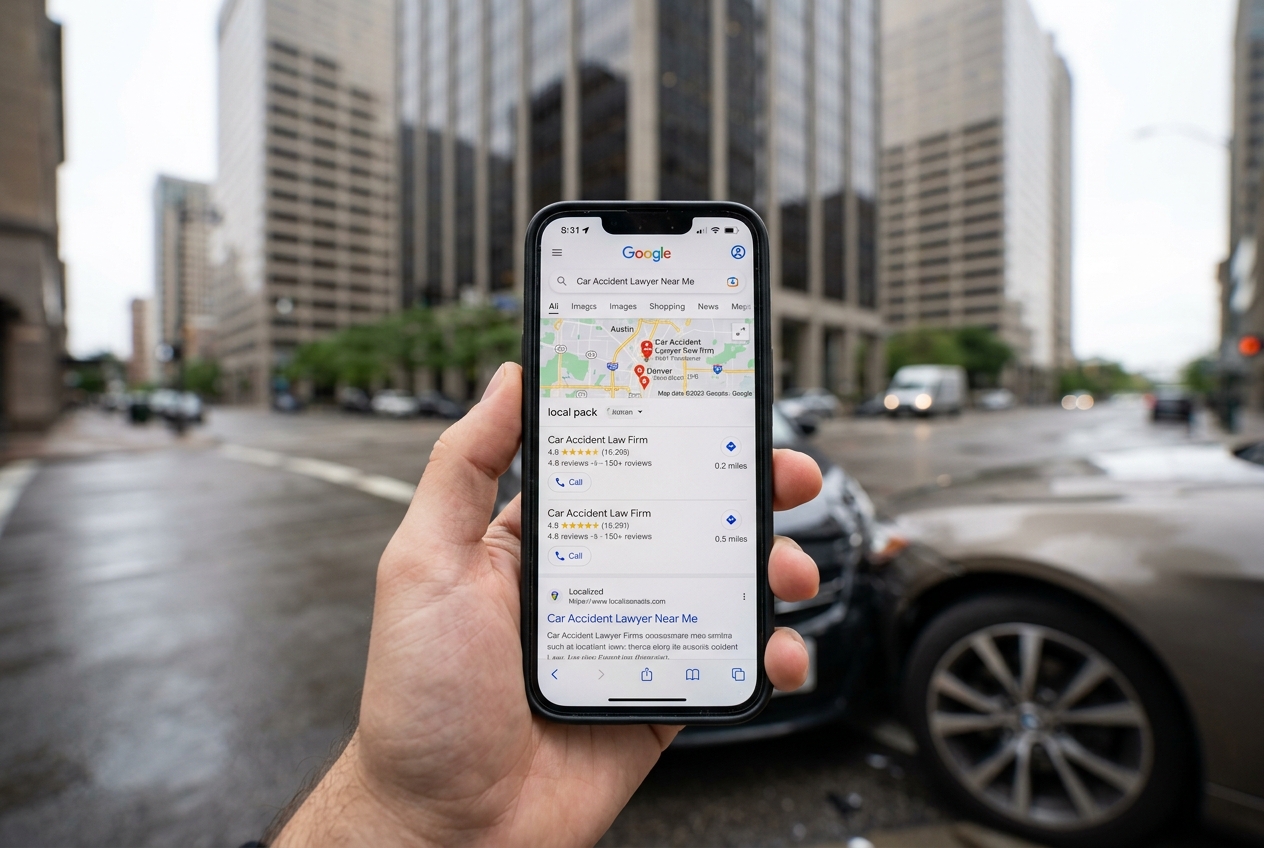
When someone searches “car accident lawyer near me,” they’re not browsing — they’re in crisis mode and ready to call the first firm they trust. For personal injury lawyers, that moment is everything. Using local SEO to show up for ‘car accident lawyer near me’ at the right time isn’t just smart marketing strategy — it’s how you make sure your firm is the one they find. Miss that window, and they’re calling someone else.
A strong Google presence isn’t a luxury anymore; it’s table stakes for any service-based business trying to meet immediate local demand. From your Google Business Profile to mobile optimization, the right local SEO approach can meaningfully boost your visibility and client conversions. This guide walks through the practical steps to get your firm in front of high-intent searchers exactly when they need you.
Optimizing for Urgency-Driven Keywords
When someone searches “car accident lawyer near me,” they’re usually not doing research — they’re looking for help right now. That urgency makes local SEO one of the highest-leverage investments a personal injury firm can make.
According to Google, 46% of all searches have local intent, which is critical for service-focused businesses like law firms. A BrightLocal study found that 78% of local mobile searches result in an in-person purchase — making local SEO an essential part of your marketing plan, not an optional add-on.
Start with your Google Business Profile (GBP). Make sure your business name, address, and phone number are accurate and consistent with your website. And be specific with your services — instead of listing “legal services,” use terms like “car accident representation” or “personal injury legal support.” That specificity helps Google match your profile to the right searches.
Reviews matter more than most firms realize. Moz has found that reviews influence SEO rankings, and BrightLocal reports that 91% of consumers factor in reviews when choosing a business. Encourage satisfied clients to leave feedback on your GBP. Strong reviews build trust and improve your ranking — two things that directly affect whether someone calls you or scrolls past.
Spend time on local keyword research. Google Keyword Planner can surface the terms people in your area are actually searching. Focus on long-tail, location-specific phrases like “Naples car accident attorney” or “Tampa personal injury lawyer” rather than broad terms you’ll never rank for.
Locally-focused content is also worth the effort. Blog posts or landing pages covering local accident statistics, recent cases, or the specific legal process after an auto accident in your city — all of that signals relevance to Google and usefulness to your potential clients.
Don’t overlook local directories. Businesses listed consistently across platforms like Yelp, Avvo, and FindLaw receive up to 73% more engagement, according to available research. Consistency across those listings reinforces your credibility with search engines.
Local backlinks are another underused asset. Reaching out to local news outlets or community organizations to be featured in their content can generate high-quality backlinks that meaningfully improve your search visibility.
Finally, mobile optimization is non-negotiable for urgency-driven searches. Someone who just got into an accident is almost certainly on their phone. Your site needs to load fast and be easy to navigate — or they’re gone before they ever see your phone number.
Building Landing Pages for Localized Searches
A single generic “contact us” page won’t cut it when someone in a specific city is searching for a lawyer in their neighborhood. Localized landing pages — built around specific geographic areas — give your firm a much stronger chance of showing up when and where it counts.
According to a Think with Google report, 76% of people who conduct a local search on their smartphone visit a related business within a day. That stat alone makes the case for landing pages that speak directly to where your potential clients are.
The basics: weave in local identifiers naturally — city names, neighborhood references, nearby landmarks. Don’t keyword-stuff; just write like you’re speaking to someone in that community. A firm in Tampa might reference the specific intersections or highways where accidents commonly occur, or note their involvement in local traffic safety events. That kind of detail signals local credibility in a way generic content simply can’t.
Local testimonials are especially powerful on these pages. A review from someone in the same city carries more weight than a five-star rating from an unnamed source. BrightLocal found that 87% of consumers read online reviews for local businesses — and a review that says “I was in an accident on I-275 and called this firm the same day” is far more convincing than a vague compliment.
Voice search is worth optimizing for, too. More people are asking their phones things like “Who’s the best car accident lawyer near me?” in a natural, conversational way. Structure your page content to answer those questions directly. Microsoft research shows that 72% of voice-activated speaker owners use them as part of their daily routine — that’s a real audience, not a future trend.
And of course, speed matters. Google research found that 53% of mobile users will leave a page that takes longer than three seconds to load. A fast, clean, easy-to-navigate page doesn’t just rank better — it converts better.
Optimizing Maps Listings for Immediate Calls
When someone searches for a car accident lawyer on their phone, the Google Maps results often appear before anything else. For personal injury attorneys, that real estate is incredibly valuable — and often underdeveloped.
Google’s own research shows that 76% of people who search for something nearby visit a related business within a day, and 28% of those searches result in a purchase. For attorneys, that’s a direct line from search to potential client.
Start with the fundamentals: your Google Business Profile should be fully filled out — name, address, phone number, website, hours of operation. Everything should match your website and other directory listings exactly. Inconsistencies erode trust with Google and with searchers.
Reviews are the next priority. An overwhelming 93% of consumers use online reviews to evaluate a business, per BrightLocal. Ask satisfied clients to leave feedback, and respond to every review — including the negative ones. How you handle criticism tells potential clients a lot about how you handle clients.
Photos and videos also move the needle. According to Google, local businesses that add photos receive 42% more requests for directions and 35% more click-throughs to their websites than those that don’t. Share images of your office and your team — give people a sense of who you are before they ever call.
Include relevant keywords naturally in your profile description. Terms like “car accident lawyer” and “personal injury attorney” help Google understand when to surface your listing for the right searches.
Consistent local citations — your name, address, and phone number listed accurately across reputable directories — reinforce your legitimacy in Google’s eyes. The more trustworthy sources confirm your information, the more confidently Google will show your listing.
Google Posts are an underused feature worth exploring. A limited-time free consultation offer or a community event announcement can give searchers a reason to engage directly from your Maps listing before they even visit your site.
Done well, your Maps listing becomes more than a digital business card — it becomes the first handshake between your firm and someone who needs help right now.
Frequently Asked Questions
What are effective strategies for using local SEO to show up for ‘car accident lawyer near me’ at the right time?
Fully optimize your Google Business Profile with accurate contact information, your service area, and quality images. Collect and integrate client reviews to build credibility. Include location-specific keywords in your website content and meta descriptions. Implement schema markup to help search engines understand your content. And keep your business citations consistent across online directories to strengthen local search rankings.
How can firms improve results with local SEO for urgent, high-intent searches?
Engage with your community both online and offline. Encourage satisfied clients to leave detailed reviews and respond to all feedback promptly. Create localized content that addresses specific community concerns related to car accidents. Use social media to amplify that content and drive traffic back to your site. Monitor your results with analytics tools and adjust your approach based on what’s actually working.
Why does showing up for local searches at the right moment matter for firm growth?
When your firm appears at the top of local results precisely when someone needs help, you’re not just getting visibility — you’re getting qualified leads with immediate intent. Capturing those moments consistently is how you grow a client base, not just a web presence.
Moving Forward
The strategies covered here — local SEO optimization, tailored landing pages, and a well-maintained Google Maps presence — all work together to put your firm in front of the right people at the right time.
Start with the basics: clean up your Google Business Profile, get consistent across local directories, and make sure your site is fast on mobile. Then layer in localized content and a steady flow of client reviews. Those aren’t glamorous tactics, but they’re the ones that actually move rankings.
If you’re ready to go further, a consultation with a local SEO specialist can help you identify the gaps specific to your market and build a strategy around your firm’s goals. You can also explore real-world results from firms that have taken this approach to see what’s possible before you commit to a direction.

When Someone Searches “Car Accident Lawyer Near Me,” They’re Ready to Call
When someone searches “car accident lawyer near me,” they’re not browsing — they’re in crisis mode and ready to call the first firm they trust. For personal injury lawyers, that moment is everything. Using local SEO to show up for ‘car accident lawyer near me’ at the right time isn’t just smart marketing strategy — it’s how you make sure your firm is the one they find. Miss that window, and they’re calling someone else.
A strong Google presence isn’t a luxury anymore; it’s table stakes for any service-based business trying to meet immediate local demand. From your Google Business Profile to mobile optimization, the right local SEO approach can meaningfully boost your visibility and client conversions. This guide walks through the practical steps to get your firm in front of high-intent searchers exactly when they need you.
Optimizing for Urgency-Driven Keywords
When someone searches “car accident lawyer near me,” they’re usually not doing research — they’re looking for help right now. That urgency makes local SEO one of the highest-leverage investments a personal injury firm can make.
According to Google, 46% of all searches have local intent, which is critical for service-focused businesses like law firms. A BrightLocal study found that 78% of local mobile searches result in an in-person purchase — making local SEO an essential part of your marketing plan, not an optional add-on.
Start with your Google Business Profile (GBP). Make sure your business name, address, and phone number are accurate and consistent with your website. And be specific with your services — instead of listing “legal services,” use terms like “car accident representation” or “personal injury legal support.” That specificity helps Google match your profile to the right searches.
Reviews matter more than most firms realize. Moz has found that reviews influence SEO rankings, and BrightLocal reports that 91% of consumers factor in reviews when choosing a business. Encourage satisfied clients to leave feedback on your GBP. Strong reviews build trust and improve your ranking — two things that directly affect whether someone calls you or scrolls past.
Spend time on local keyword research. Google Keyword Planner can surface the terms people in your area are actually searching. Focus on long-tail, location-specific phrases like “Naples car accident attorney” or “Tampa personal injury lawyer” rather than broad terms you’ll never rank for.
Locally-focused content is also worth the effort. Blog posts or landing pages covering local accident statistics, recent cases, or the specific legal process after an auto accident in your city — all of that signals relevance to Google and usefulness to your potential clients.
Don’t overlook local directories. Businesses listed consistently across platforms like Yelp, Avvo, and FindLaw receive up to 73% more engagement, according to available research. Consistency across those listings reinforces your credibility with search engines.
Local backlinks are another underused asset. Reaching out to local news outlets or community organizations to be featured in their content can generate high-quality backlinks that meaningfully improve your search visibility.
Finally, mobile optimization is non-negotiable for urgency-driven searches. Someone who just got into an accident is almost certainly on their phone. Your site needs to load fast and be easy to navigate — or they’re gone before they ever see your phone number.
Building Landing Pages for Localized Searches
A single generic “contact us” page won’t cut it when someone in a specific city is searching for a lawyer in their neighborhood. Localized landing pages — built around specific geographic areas — give your firm a much stronger chance of showing up when and where it counts.
According to a Think with Google report, 76% of people who conduct a local search on their smartphone visit a related business within a day. That stat alone makes the case for landing pages that speak directly to where your potential clients are.
The basics: weave in local identifiers naturally — city names, neighborhood references, nearby landmarks. Don’t keyword-stuff; just write like you’re speaking to someone in that community. A firm in Tampa might reference the specific intersections or highways where accidents commonly occur, or note their involvement in local traffic safety events. That kind of detail signals local credibility in a way generic content simply can’t.
Local testimonials are especially powerful on these pages. A review from someone in the same city carries more weight than a five-star rating from an unnamed source. BrightLocal found that 87% of consumers read online reviews for local businesses — and a review that says “I was in an accident on I-275 and called this firm the same day” is far more convincing than a vague compliment.
Voice search is worth optimizing for, too. More people are asking their phones things like “Who’s the best car accident lawyer near me?” in a natural, conversational way. Structure your page content to answer those questions directly. Microsoft research shows that 72% of voice-activated speaker owners use them as part of their daily routine — that’s a real audience, not a future trend.
And of course, speed matters. Google research found that 53% of mobile users will leave a page that takes longer than three seconds to load. A fast, clean, easy-to-navigate page doesn’t just rank better — it converts better.
Optimizing Maps Listings for Immediate Calls
When someone searches for a car accident lawyer on their phone, the Google Maps results often appear before anything else. For personal injury attorneys, that real estate is incredibly valuable — and often underdeveloped.
Google’s own research shows that 76% of people who search for something nearby visit a related business within a day, and 28% of those searches result in a purchase. For attorneys, that’s a direct line from search to potential client.
Start with the fundamentals: your Google Business Profile should be fully filled out — name, address, phone number, website, hours of operation. Everything should match your website and other directory listings exactly. Inconsistencies erode trust with Google and with searchers.
Reviews are the next priority. An overwhelming 93% of consumers use online reviews to evaluate a business, per BrightLocal. Ask satisfied clients to leave feedback, and respond to every review — including the negative ones. How you handle criticism tells potential clients a lot about how you handle clients.
Photos and videos also move the needle. According to Google, local businesses that add photos receive 42% more requests for directions and 35% more click-throughs to their websites than those that don’t. Share images of your office and your team — give people a sense of who you are before they ever call.
Include relevant keywords naturally in your profile description. Terms like “car accident lawyer” and “personal injury attorney” help Google understand when to surface your listing for the right searches.
Consistent local citations — your name, address, and phone number listed accurately across reputable directories — reinforce your legitimacy in Google’s eyes. The more trustworthy sources confirm your information, the more confidently Google will show your listing.
Google Posts are an underused feature worth exploring. A limited-time free consultation offer or a community event announcement can give searchers a reason to engage directly from your Maps listing before they even visit your site.
Done well, your Maps listing becomes more than a digital business card — it becomes the first handshake between your firm and someone who needs help right now.
Frequently Asked Questions
What are effective strategies for using local SEO to show up for ‘car accident lawyer near me’ at the right time?
Fully optimize your Google Business Profile with accurate contact information, your service area, and quality images. Collect and integrate client reviews to build credibility. Include location-specific keywords in your website content and meta descriptions. Implement schema markup to help search engines understand your content. And keep your business citations consistent across online directories to strengthen local search rankings.
How can firms improve results with local SEO for urgent, high-intent searches?
Engage with your community both online and offline. Encourage satisfied clients to leave detailed reviews and respond to all feedback promptly. Create localized content that addresses specific community concerns related to car accidents. Use social media to amplify that content and drive traffic back to your site. Monitor your results with analytics tools and adjust your approach based on what’s actually working.
Why does showing up for local searches at the right moment matter for firm growth?
When your firm appears at the top of local results precisely when someone needs help, you’re not just getting visibility — you’re getting qualified leads with immediate intent. Capturing those moments consistently is how you grow a client base, not just a web presence.
Moving Forward
The strategies covered here — local SEO optimization, tailored landing pages, and a well-maintained Google Maps presence — all work together to put your firm in front of the right people at the right time.
Start with the basics: clean up your Google Business Profile, get consistent across local directories, and make sure your site is fast on mobile. Then layer in localized content and a steady flow of client reviews. Those aren’t glamorous tactics, but they’re the ones that actually move rankings.
If you’re ready to go further, a consultation with a local SEO specialist can help you identify the gaps specific to your market and build a strategy around your firm’s goals. You can also explore real-world results from firms that have taken this approach to see what’s possible before you commit to a direction.
Published on May 6, 2026

