
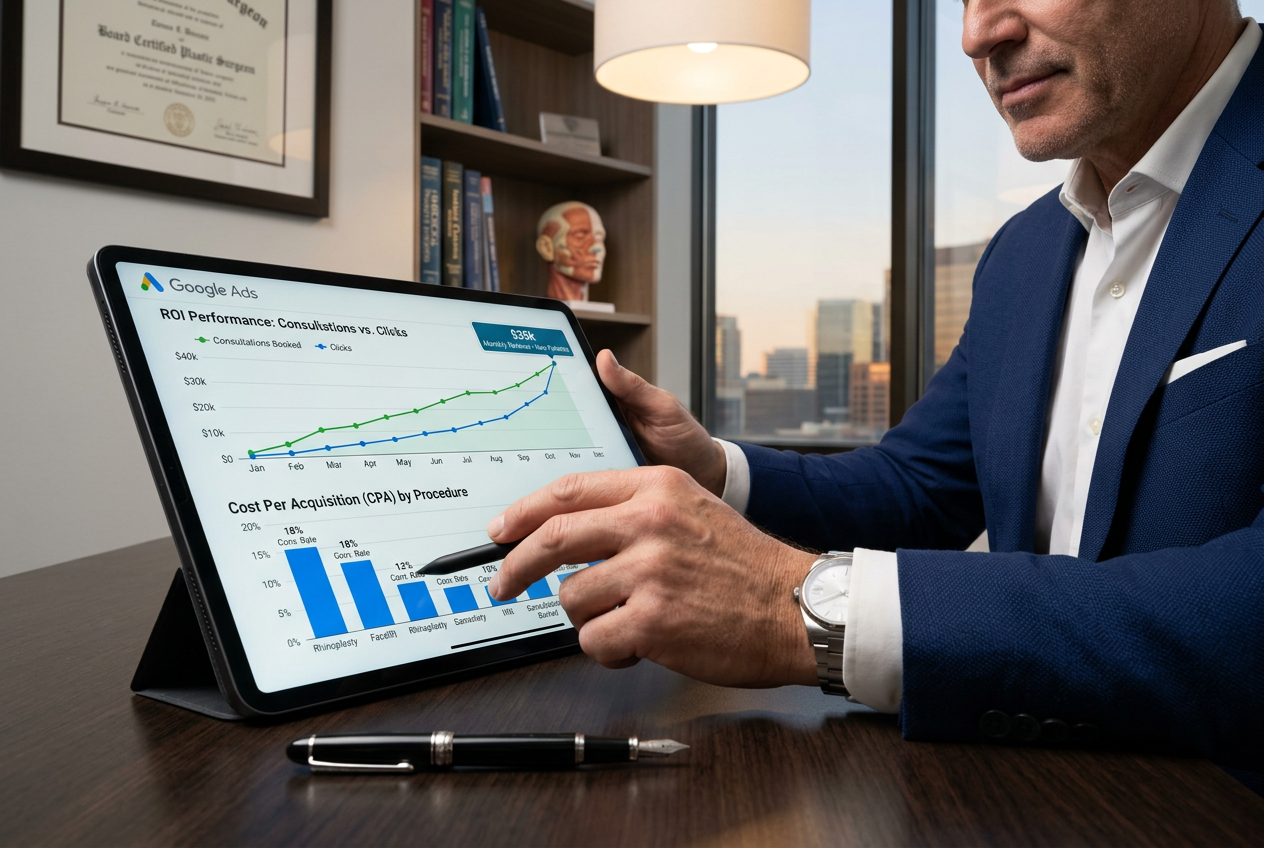
If your Google Ads aren’t bringing in the right patients, the problem usually isn’t your budget — it’s your strategy. Knowing how to market a plastic surgery practice online means more than just running ads. It means understanding what your ideal patients are searching for, speaking to them clearly, and tracking what actually drives bookings. When patients search for cosmetic enhancements, being the practice that meets them with the right message at the right moment makes all the difference.
The data available today lets you tailor your marketing with real precision. By interpreting search demand, crafting compelling ad messages, and tracking your return on investment properly, you can make sure your efforts don’t just get seen — they get results. Here’s how.
Analyzing Search Demand in Cosmetic Procedures
Understanding search demand is foundational for any plastic surgeon looking to sharpen their online marketing. Knowing the volume and nature of what people are searching helps you target potential patients more effectively and stop guessing at what they want.
Google Trends is a great starting point. Interest in procedures like “Botox” and “breast augmentation” reliably peaks before summer and the holiday season, as people prepare for vacations or events. Recognizing these patterns lets you time your campaigns to hit when demand is already rising.
Google’s Keyword Planner goes a layer deeper, showing the specific terms patients actually type in. Phrases like “best facelift surgeon near me” or “affordable liposuction” tell you a lot about what matters to someone before they book. Build those terms into your campaigns and your ads become far more relevant.
Your website content matters just as much. Blogs covering common procedures, recovery timelines, or new techniques attract patients who are still in the research phase — often the most valuable people to reach early. The Aesthetic Society reports that online educational resources significantly influence patient decisions, so well-crafted content isn’t optional; it’s a competitive advantage.
Local search demand deserves its own attention. Most patients prefer a nearby clinic, so geo-targeting in Google Ads ensures your ads reach people within a practical distance of your practice. Claiming and optimizing your Google Business Profile rounds this out, pushing you higher in local results and sending more relevant traffic your way.
Demographic data adds another layer of precision. Statista data shows that women aged 40–54 make up 37% of cosmetic surgery patients. If your messaging speaks directly to that group’s concerns — recovery time, natural-looking results, fitting procedures around a busy schedule — you’ll see stronger engagement.
Finally, keep a close eye on performance metrics: click-through rates, conversion rates, and search impression share. Regular analysis lets you make data-driven adjustments rather than running on assumption, which keeps your spend efficient over time.
Designing Ad Copy That Converts High-Value Patients
The right ad copy can be the difference between a scroll and a consultation booking. Here’s what actually moves the needle.
Understand Your Audience
Start by getting specific about who you’re trying to reach. Are they interested in cosmetic enhancements, reconstructive procedures, or both? Age, income level, and lifestyle all shape how people respond to messaging. A 2022 IBISWorld study found that most cosmetic surgery patients are between 35 and 50, with many motivated by lifestyle or career considerations. Speak to those motivations directly and your copy will land harder.
Use Clear, Concise Language
Patients searching online often want quick answers. Skip the jargon. “Nose reshaping” will outperform “rhinoplasty” in both clarity and search volume among general audiences. Make it easy for someone to understand what you offer before they’ve finished reading the first line.
Highlight Unique Selling Points
What actually sets your practice apart? It might be a surgeon’s specific track record, a particular technology you use, or an unusually smooth patient experience. Pick one thing and lead with it. McKinsey research found that businesses with a single, clear value proposition can see conversion rates jump by 50%.
Incorporate Social Proof
Trust is everything in this space. Pull in a snippet from a patient review, or mention your overall rating. The 2023 BrightLocal Consumer Review Survey found that 87% of consumers read online reviews before choosing a local business. An ad that signals credibility can tip a hesitant prospect toward booking.
Use Compelling Calls to Action
“Schedule a consultation” or “View before and after photos” do real work — they give the reader a clear next step and hint at what’s waiting on the other side. Generic CTAs like “click here” or “learn more”
You May Be Asking
How can plastic surgeons attract more patients online?
Plastic surgeons can attract more patients online by using targeted digital marketing strategies. This includes optimizing their website for search engines with relevant keywords like “plastic surgery” and “cosmetic procedures,” engaging in PPC advertising such as Google Ads with precise targeting and location-based settings, leveraging social media platforms to showcase services and success stories, and maintaining a strong online reputation through positive patient reviews. Utilizing content marketing by posting informative articles and before-and-after galleries also attracts potential patients.
What marketing strategies work best for cosmetic surgery practices?
Effective marketing strategies for cosmetic surgery practices include a mix of SEO to improve organic search visibility, PPC advertising to reach a targeted audience quickly, and social media engagement to build relationships and showcase expertise. Additionally, email marketing campaigns that provide valuable insights and offers to a curated audience can be effective. Networking with other medical professionals for referrals, hosting informational webinars, and ensuring an updated and easy-to-navigate website are also critical components.
How do before-and-after photos impact plastic surgery leads?
Before-and-after photos significantly impact plastic surgery leads as they offer tangible evidence of a surgeon’s skill and the results prospective patients might expect. These photos build trust and credibility, helping prospective patients visualize potential outcomes. Clear and well-photographed images can increase engagement on websites and social media platforms, often serving as a powerful tool in converting leads into consultations. However, it’s crucial these images are accompanied by clear explanations and disclaimers about results varying from patient to patient.
Building Confidence Ahead
Understanding the intricacies of search demand, ad copy creation, and ROI tracking can greatly enhance the marketing strategies of plastic surgery practices. These strategies set the foundation for connecting with potential patients and converting interest into meaningful consultations. Business owners can improve campaign success by paying attention to keyword usage, demographic targeting, and lead quality alongside digital tools like Google Ads. Careful monitoring and adjustment based on real-time analytics empower marketers to make informed decisions, optimizing their advertising efforts continually.
To take your marketing efforts to the next level, consider refining these strategies based on your unique goals and patient demographics. Emphasizing the quality of leads and thoughtful engagement will maximize the impact of your advertising spend. If you’re interested in tailoring these strategies further, reach out to Aginto for a complimentary consultation. Let’s discuss how to align your marketing tactics with your business objectives for a more prosperous practice.
If your Google Ads aren’t bringing in the right patients, the problem usually isn’t your budget — it’s your strategy. Knowing how to market a plastic surgery practice online means more than just running ads. It means understanding what your ideal patients are searching for, speaking to them clearly, and tracking what actually drives bookings. When patients search for cosmetic enhancements, being the practice that meets them with the right message at the right moment makes all the difference.
The data available today lets you tailor your marketing with real precision. By interpreting search demand, crafting compelling ad messages, and tracking your return on investment properly, you can make sure your efforts don’t just get seen — they get results. Here’s how.
Analyzing Search Demand in Cosmetic Procedures
Understanding search demand is foundational for any plastic surgeon looking to sharpen their online marketing. Knowing the volume and nature of what people are searching helps you target potential patients more effectively and stop guessing at what they want.
Google Trends is a great starting point. Interest in procedures like “Botox” and “breast augmentation” reliably peaks before summer and the holiday season, as people prepare for vacations or events. Recognizing these patterns lets you time your campaigns to hit when demand is already rising.
Google’s Keyword Planner goes a layer deeper, showing the specific terms patients actually type in. Phrases like “best facelift surgeon near me” or “affordable liposuction” tell you a lot about what matters to someone before they book. Build those terms into your campaigns and your ads become far more relevant.
Your website content matters just as much. Blogs covering common procedures, recovery timelines, or new techniques attract patients who are still in the research phase — often the most valuable people to reach early. The Aesthetic Society reports that online educational resources significantly influence patient decisions, so well-crafted content isn’t optional; it’s a competitive advantage.
Local search demand deserves its own attention. Most patients prefer a nearby clinic, so geo-targeting in Google Ads ensures your ads reach people within a practical distance of your practice. Claiming and optimizing your Google Business Profile rounds this out, pushing you higher in local results and sending more relevant traffic your way.
Demographic data adds another layer of precision. Statista data shows that women aged 40–54 make up 37% of cosmetic surgery patients. If your messaging speaks directly to that group’s concerns — recovery time, natural-looking results, fitting procedures around a busy schedule — you’ll see stronger engagement.
Finally, keep a close eye on performance metrics: click-through rates, conversion rates, and search impression share. Regular analysis lets you make data-driven adjustments rather than running on assumption, which keeps your spend efficient over time.
Designing Ad Copy That Converts High-Value Patients
The right ad copy can be the difference between a scroll and a consultation booking. Here’s what actually moves the needle.
Understand Your Audience
Start by getting specific about who you’re trying to reach. Are they interested in cosmetic enhancements, reconstructive procedures, or both? Age, income level, and lifestyle all shape how people respond to messaging. A 2022 IBISWorld study found that most cosmetic surgery patients are between 35 and 50, with many motivated by lifestyle or career considerations. Speak to those motivations directly and your copy will land harder.
Use Clear, Concise Language
Patients searching online often want quick answers. Skip the jargon. “Nose reshaping” will outperform “rhinoplasty” in both clarity and search volume among general audiences. Make it easy for someone to understand what you offer before they’ve finished reading the first line.
Highlight Unique Selling Points
What actually sets your practice apart? It might be a surgeon’s specific track record, a particular technology you use, or an unusually smooth patient experience. Pick one thing and lead with it. McKinsey research found that businesses with a single, clear value proposition can see conversion rates jump by 50%.
Incorporate Social Proof
Trust is everything in this space. Pull in a snippet from a patient review, or mention your overall rating. The 2023 BrightLocal Consumer Review Survey found that 87% of consumers read online reviews before choosing a local business. An ad that signals credibility can tip a hesitant prospect toward booking.
Use Compelling Calls to Action
“Schedule a consultation” or “View before and after photos” do real work — they give the reader a clear next step and hint at what’s waiting on the other side. Generic CTAs like “click here” or “learn more”
You May Be Asking
How can plastic surgeons attract more patients online?
Plastic surgeons can attract more patients online by using targeted digital marketing strategies. This includes optimizing their website for search engines with relevant keywords like “plastic surgery” and “cosmetic procedures,” engaging in PPC advertising such as Google Ads with precise targeting and location-based settings, leveraging social media platforms to showcase services and success stories, and maintaining a strong online reputation through positive patient reviews. Utilizing content marketing by posting informative articles and before-and-after galleries also attracts potential patients.
What marketing strategies work best for cosmetic surgery practices?
Effective marketing strategies for cosmetic surgery practices include a mix of SEO to improve organic search visibility, PPC advertising to reach a targeted audience quickly, and social media engagement to build relationships and showcase expertise. Additionally, email marketing campaigns that provide valuable insights and offers to a curated audience can be effective. Networking with other medical professionals for referrals, hosting informational webinars, and ensuring an updated and easy-to-navigate website are also critical components.
How do before-and-after photos impact plastic surgery leads?
Before-and-after photos significantly impact plastic surgery leads as they offer tangible evidence of a surgeon’s skill and the results prospective patients might expect. These photos build trust and credibility, helping prospective patients visualize potential outcomes. Clear and well-photographed images can increase engagement on websites and social media platforms, often serving as a powerful tool in converting leads into consultations. However, it’s crucial these images are accompanied by clear explanations and disclaimers about results varying from patient to patient.
Building Confidence Ahead
Understanding the intricacies of search demand, ad copy creation, and ROI tracking can greatly enhance the marketing strategies of plastic surgery practices. These strategies set the foundation for connecting with potential patients and converting interest into meaningful consultations. Business owners can improve campaign success by paying attention to keyword usage, demographic targeting, and lead quality alongside digital tools like Google Ads. Careful monitoring and adjustment based on real-time analytics empower marketers to make informed decisions, optimizing their advertising efforts continually.
To take your marketing efforts to the next level, consider refining these strategies based on your unique goals and patient demographics. Emphasizing the quality of leads and thoughtful engagement will maximize the impact of your advertising spend. If you’re interested in tailoring these strategies further, reach out to Aginto for a complimentary consultation. Let’s discuss how to align your marketing tactics with your business objectives for a more prosperous practice.
Published on March 10, 2026
About the Author: Chris Williams