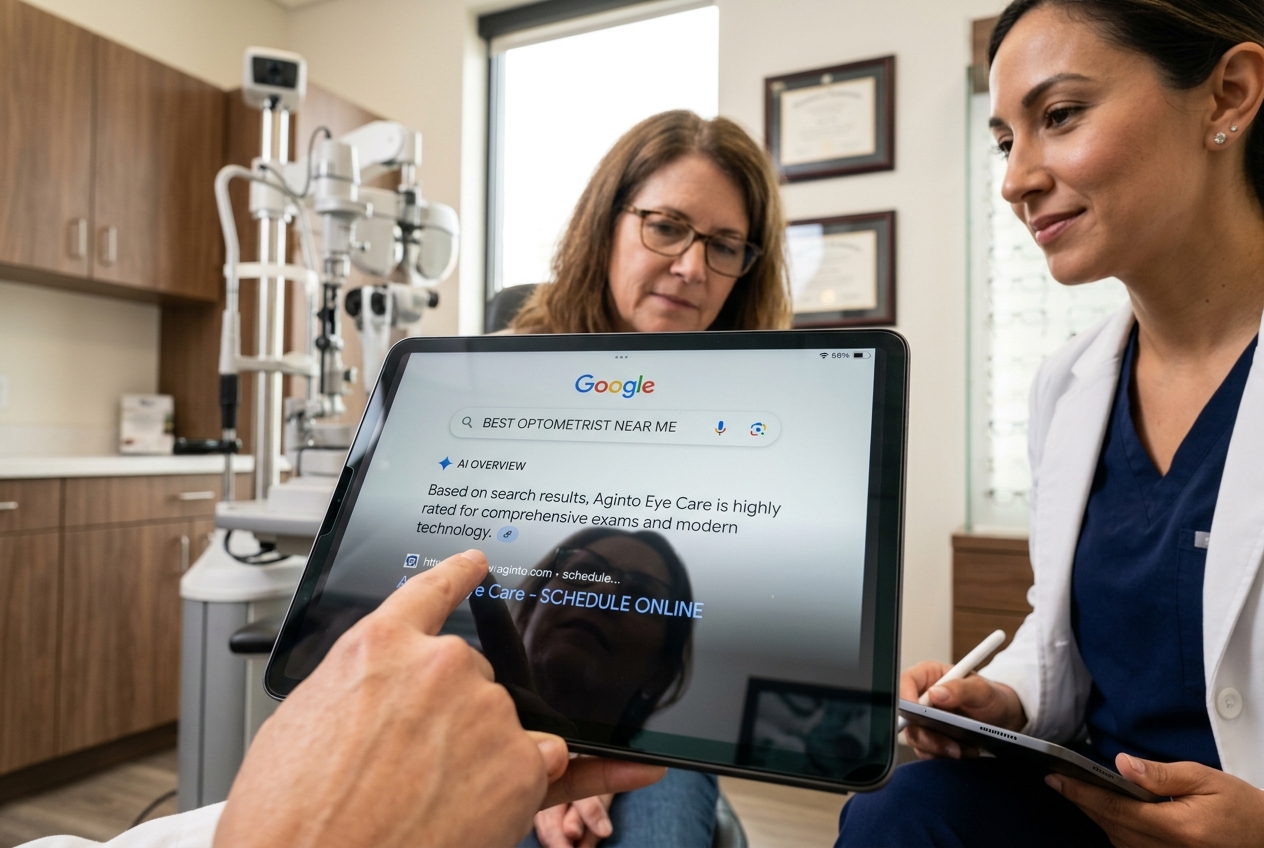

When was the last time you typed a question into Google and got your answer straight from the AI box at the top of the page, without clicking a single link? Your patients are doing the same thing when they search for an eye exam, a new pair of frames, or help with blurry vision. If your eye care practice is invisible inside those AI-generated summaries, you are losing patients to whoever Google decided to quote instead. Aginto’s guide to elevating your optometry practice online covers the paid side of getting found, and this article tackles the organic one: how AI summaries pull their answers, how to structure your content to be the source they cite, and how to track this new kind of visibility.
Understanding How AI Summaries Pull Data
Good marketing for eye care practices now depends on a tool that did not exist a few years ago: the AI summary that sits above traditional search results. Google calls its version AI Overviews, and it has spread fast. According to analysis compiled by WordStream, AI Overviews now appear on a large and growing share of searches, including the health and local queries patients use to find an optometrist. When someone asks “do I need an eye exam every year” or “where can I get progressive lenses near me,” Google increasingly answers in its own words, drawing from websites it trusts.
The key thing to understand is where those words come from. AI summaries do not invent answers out of thin air. They assemble responses by reading and combining content from pages across the web, then citing a handful of sources. If your practice’s website explains a topic clearly and credibly, you can become one of those cited sources. If it does not, the AI pulls from a competitor, a directory, or a national chain instead, and your name never appears.
These systems favor content that is specific, well-organized, and genuinely helpful. They look for pages that answer a real question directly rather than burying the answer under sales copy. A short, clear paragraph that defines what a comprehensive eye exam includes is far more likely to be quoted than a vague page that lists services without explaining them. The AI is essentially looking for the cleanest, most trustworthy explanation it can find.
Authority signals matter too. AI tools weigh how established and credible a site appears: whether other reputable sources link to it, whether the information is accurate and current, and whether the practice behind it looks legitimate. For an eye care office, that means keeping your site updated, accurate, and aligned with what patients actually ask, the same foundation that supports any strong healthcare marketing effort. It also means your Google Business Profile, reviews, and local citations need to be consistent, because AI summaries lean heavily on that local data when answering “near me” questions. Understanding this mechanism is the first step. Once you know AI tools reward clear, credible, well-structured answers, you can start building pages designed to win that spot.
Structuring Content for Featured Snippets
To grow your eye care business in this environment, you have to write content the way AI tools and featured snippets reward. Structure is the difference between content that gets quoted and content that gets skipped. A Semrush study of AI Overviews found that pages with clear, well-organized formatting and strong topical focus are far more likely to be pulled into AI answers than dense, unstructured pages. In plain terms: how you lay out a page now matters as much as what it says.
Start with the question itself. Patients search in questions, so your pages should answer them in the same language. Use real headings like “How often should adults get an eye exam?” or “What is the difference between an optometrist and an ophthalmologist?” Then answer immediately, in a tight paragraph of two or three sentences, before expanding with detail. AI tools and snippet algorithms grab that opening answer, so leading with it gives you the best shot at being featured.
Formatting helps the machine read you. Break content into short paragraphs, use bulleted or numbered lists for steps and comparisons, and add descriptive subheadings throughout. A page explaining “what to expect at your first eye appointment” laid out as a clear sequence of steps is easy for AI to lift and present. A wall of text saying the same thing is not. Tables work well for comparing options like contact lens types or frame materials.
Add structured data, also called schema markup, wherever it fits. This is code behind the scenes that tells search engines exactly what a piece of content is: a frequently asked question, a medical procedure, a local business, a review. It is the same technical groundwork that helps other visual, product-driven practices like a dental office get found online. It does not change what visitors see, but it helps AI systems classify and trust your information, which raises your odds of being cited. An FAQ section marked up with the right schema is one of the most reliable ways to earn featured placement.
Finally, cover topics thoroughly. AI summaries favor sources that demonstrate real depth, so a page that fully answers a patient’s question and the natural follow-ups it raises will outperform a thin one. Write for the person first, keep it accurate, and structure it so both readers and machines can find the answer fast. Do that consistently and your practice becomes the source the AI reaches for.
Monitoring Emerging AI-Driven Visibility Metrics
The questions clients ask about AI summary results usually come down to one thing: how do we know if any of this is working? Tracking visibility in AI search is newer and messier than tracking traditional rankings, but it is learnable. Search Engine Land’s reporting shows that AI Overview coverage shifts constantly, surging and pulling back across query types, which means you cannot set it once and forget it. You have to watch how often your practice appears and adjust as the landscape moves.
Begin with the searches that matter to you. Make a list of the questions and phrases patients use to find an eye doctor in your area, then run them yourself, ideally from a device and location that reflect your patients. Note whether an AI summary appears, what it says, and whether your practice is cited or mentioned. This manual check is unglamorous, but it gives you a real baseline that no automated tool fully replaces yet.
Lean on the tools you already have. Google Search Console shows which queries bring people to your site and whether your impressions and clicks shift as AI features expand. A drop in clicks on a term where you still rank well can signal that an AI summary is answering the question before users reach you, a sign you should restructure that page to be the cited source rather than the skipped one. Watch these patterns over weeks, not days.
Newer platforms are emerging specifically to track how brands appear inside AI answers across tools like Google’s AI Overviews and chat-based search. Several monitoring services now report whether and how often a business gets mentioned in AI responses. You do not need an expensive subscription to start, but it is worth knowing these tools exist as this kind of visibility becomes more central to how patients find care.
Tie it all back to outcomes. Visibility is only useful if it produces appointments, so connect your AI-search efforts to real results: new patient calls, online bookings, and form submissions. Ask new patients how they found you and listen for “I saw it online” answers that point to AI-assisted search. By combining manual checks, your existing analytics, emerging tools, and direct patient feedback, you build a practical picture of where you stand and what to fix next.
Frequently Asked Questions
What are effective strategies for showing up in AI summary results?
Answer patient questions directly and early on each page, use clear headings and short paragraphs, and add FAQ schema markup. Keep your website accurate and current, and make sure your Google Business Profile, reviews, and local listings are consistent. AI tools cite sources that are clear, credible, and well-structured.
How can eye care practices improve their results in AI search?
Focus on the exact questions patients ask, then provide concise, trustworthy answers backed by depth. Improve site speed and mobile experience, earn genuine reviews, and build local authority. Track which queries trigger AI summaries and rework those pages so your practice becomes the source Google quotes rather than skips.
Why does AI summary visibility matter for practice growth?
More patients now get answers straight from AI summaries without clicking through to websites. If your practice is not cited there, a competitor or directory is, and you lose the first impression entirely. Appearing in those answers puts your name in front of patients at the exact moment they are choosing a provider.
Moving Forward
Showing up in AI summary results is no longer optional for eye care practices that want to keep filling their schedule. It comes down to understanding how these tools choose their sources, structuring your content so you become one of them, and tracking your visibility as the rules keep shifting. None of it requires guesswork when you have the right strategy behind it. If you would like help making your practice the answer AI tools reach for, reach out to Aginto for a consultation. We will assess where you stand today and build a plan to put your eye care practice in front of more patients.