
How Optometrists Attract New Patients With Educational Video Content
Most patients leave their eye exam with a diagnosis they half-understand and a pamphlet they’ll never read. Video changes that — and it’s one of the most practical ways how optometrists attract new patients while building real trust with the ones they already have.
Short videos focused on conditions like presbyopia or astigmatism let patients grasp complex concepts without feeling overwhelmed. By visually linking symptoms to their causes and remedies, you encourage proactive steps toward eye health. That strengthens the patient-practitioner relationship and positions your practice as a genuine authority in ocular wellness.
Choosing Common Conditions That Need Clarification
When creating video content for an optometry practice, focusing on conditions that commonly puzzle patients is a smart starting point. Choosing the right topics helps educate your existing patients and draw in new ones. Clarity builds trust — and trust makes your practice the one people recommend.
Start with conditions people have heard of but don’t really understand. Presbyopia affects nearly everyone after 40, yet it’s routinely mistaken for just “aging eyes.” A short video explaining what’s actually happening — and how it can be managed — informs your audience and pulls in older patients who’ve been quietly wondering about their symptoms.
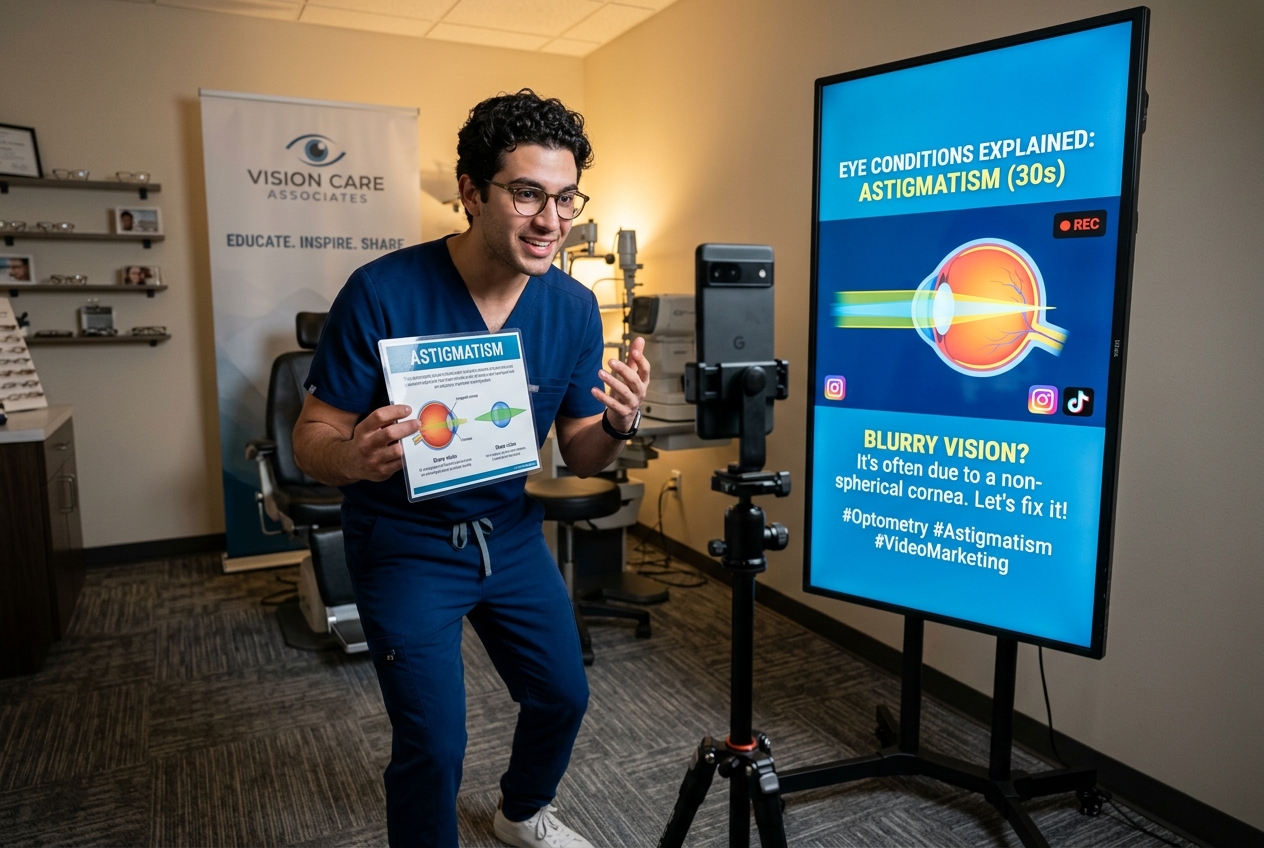
Astigmatism is another strong choice. It drives plenty of searches, but the term itself confuses people. In 30 seconds, you can show what an irregularly shaped cornea actually does to vision, use a quick blur-to-clear visual, and mention that corrective lenses can fix it. That’s enough to prompt someone to book an appointment.
For parents and younger patients, myopia is a natural fit. With screen time driving up rates in children, a video on myopia’s progression — and simple prevention strategies like outdoor play and regular exams — resonates deeply. The National Eye Institute projects that by 2050, nearly half the global population may be affected. That kind of stat turns a general video into something that feels urgent and personal.
Dry eye syndrome is worth covering too. Skip the vague symptom lists. Talk about specific triggers — prolonged screen use, low humidity, air conditioning — and offer practical tips like artificial tears or adjusting monitor height to reduce glare. Actionable advice makes content relatable, not clinical.
Throughout all of it, lean on visuals. Before-and-after vision simulations, simple animations, and labeled diagrams make the difference between content that informs and content that actually sticks.
Choosing the right conditions, explaining them clearly, and pairing that with strong visuals gives optometrists a reliable formula — educate the patients you have, and earn the attention of the ones you want.
Using Animation to Break Down Complex Topics
Explaining eye conditions is genuinely hard. The anatomy is intricate, the terminology is dense, and patients are often anxious before you’ve said a word. Animation cuts through all of that.
The human brain processes visual information significantly faster than text. According to a study by MIT, it takes about 13 milliseconds to process an entire image. Animated sequences can use that processing speed to your advantage — showing how glaucoma gradually narrows peripheral vision, or how an irregularly shaped lens bends light the wrong way, in the time it takes to read a single paragraph.
Research published in the Journal of Educational Psychology found that people retain 65% of information three days after watching a video, compared to just 10% from reading text. For conditions like glaucoma, macular degeneration, or cataracts — where the details matter and patients need to remember their options — that gap is significant.
Animation also works well for treatment explanations. A step-by-step depiction of laser eye surgery, showing what happens and why it’s safe, does more to reduce patient anxiety than any written brochure. When people can see the process, they feel less like something is being done to them and more like they understand the plan.
Storytelling fits naturally here too. A short animated video following a patient from cataract diagnosis to post-surgery clarity — showing the emotional arc, not just the clinical steps — lands differently than an abstract explanation. Viewers can picture themselves in that story.
Practically, building an effective animated video starts with picking one condition or procedure, scripting it down to the essential points, and collaborating with both healthcare professionals and animators to make sure the content is accurate and visually clear. Thirty seconds is enough if the script is tight.
Distribute through YouTube and social media, and use targeted terms like “eye health” or “what causes blurry vision” to improve how easily people find your content. Animation isn’t just a production choice — it’s a bridge between complex medical information and the person sitting at home trying to understand what their diagnosis actually means.
Sharing Short Clips Across Multiple Platforms
Short videos only work if people see them. Spreading clips across Instagram, TikTok, and Facebook gives your content the best chance of reaching patients where they already spend their time — and each platform has its own strengths worth using deliberately.
Research by Wyzowl found that 84% of people say watching a brand’s video convinced them to buy or subscribe to a service. For healthcare providers, that influence matters. A well-placed 30-second video on astigmatism might be exactly what prompts someone to finally book the exam they’ve been putting off.
Keep the format simple: name the condition, explain it in plain language, and give viewers a reason to care or act. For astigmatism, something like — “Astigmatism is when the eye’s curve causes blurry vision. Imagine seeing a stretched image instead of a clear one. Glasses can fix that” — works because it’s concrete, brief, and ends with a solution.
Tailor the presentation to each platform without changing the core message. Instagram Stories can link directly to your booking page. TikTok’s algorithm can surface your content to people actively searching eye health topics. Facebook’s broader demographic reach invites a wider range of viewer responses and shares.
Use platform-specific tools to your advantage — strong thumbnails on Instagram, trending hashtags on TikTok, consistent posting schedules managed through tools like Buffer or Hootsuite. Consistency matters. Regular uploads keep your practice visible and build the kind of familiarity that makes people trust you before they’ve ever met you.
Invite interaction. Ask viewers to drop questions in the comments, then answer them in follow-up videos. That loop generates new content ideas and builds a genuine sense of community around your practice. A friendly, knowledgeable presence online has a way of turning casual viewers into patients who feel like they already know you.
Short clips, posted consistently across the right platforms, are one of the most efficient ways to spread useful information and stay connected to your community.
Sharper Vision Forward
Video content gives optometry practices a real edge — it makes complex topics accessible, builds credibility, and meets patients where they are. Animated sequences simplify what’s hard to explain in words. Short clips extend your reach across platforms. Together, they do the kind of patient education that a waiting room pamphlet never could.
As you build out your strategy, pay attention to which conditions get the most engagement and experiment with presentation styles. Addressing myopia for parents of young children hits differently than a presbyopia video aimed at patients in their 40s — both are worth making, but they need different angles.
If you’d like help aligning your content goals with the right execution, a free consultation with Aginto is a good place to start. Getting the strategy right from the beginning means your videos don’t just educate — they connect.