Your Website Might Be Costing You Jobs — and You’d Never Know It
Most electrical contractors running SEO strategies for home builders and contractors think the hard part is getting people to their site. It’s not. The hard part is what happens after they arrive. If your site isn’t guiding visitors toward action, reassuring them you’re legit, or loading fast on a phone, they’re gone. Simple as that. This guide breaks down the three most common website mistakes electricians make — and how to fix them.
Ignoring Clear Calls-to-Action on Key Pages
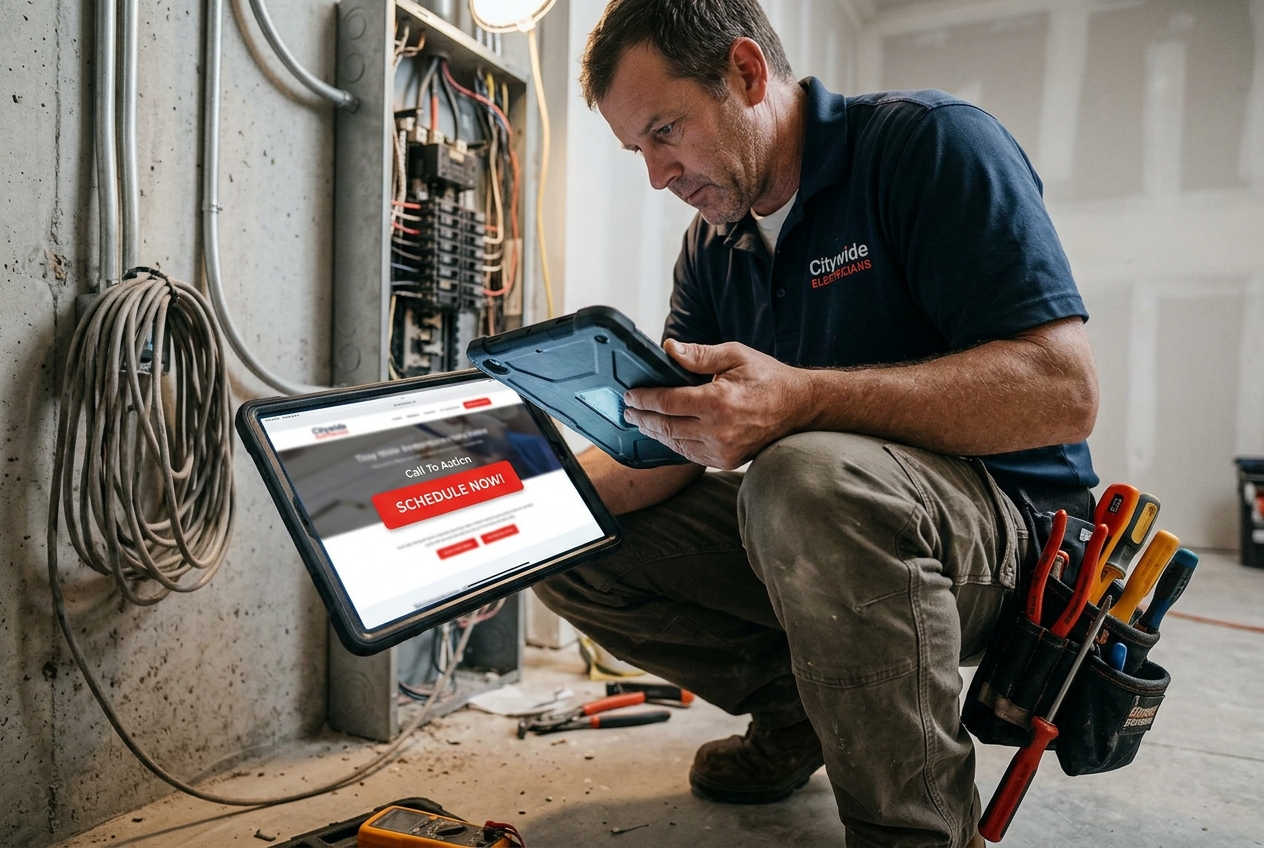
Failing to include clear calls-to-action (CTA) on key pages is a mistake many electrical contractors make, and it quietly kills conversions. A well-defined CTA tells visitors what to do next — moving them from “maybe interested” to actually reaching out. Without one, people leave confused, even if they liked what they saw.
Start with a basic audit. Pull up your homepage, service pages, and contact page. Ask yourself: is there an obvious next step on each one? Something like “Schedule a Service,” “Get a Free Estimate,” or “Call Us Now.” If you have to hunt for it, your visitors will give up before they do.
Design matters here too. CTA buttons need to stand out — contrasting color, readable size, nothing buried in the footer. According to a study by HubSpot, a red CTA button can increase conversion rates by up to 21% compared to a green one, likely because it grabs attention faster.
Placement is just as important as design. Put your primary CTA above the fold so it’s the first thing people see. On longer pages, repeat it at natural stopping points — for example, right after a section explaining what sets your electrical services apart, when a reader is most likely to be convinced.
Tailor your CTAs to the moment, too. Electrical emergencies call for urgency. A button that says “Emergency Electrical Services — Call Now” speaks directly to someone in a panic at 10pm. That kind of specificity works. A study by Epsilon found that personalized CTAs convert 202% better than generic ones because they match what the user is actually feeling.
Finally, test and refine. A/B test different wording, colors, and placements. Use analytics to see which CTAs get clicked and which ones get ignored. Small tweaks compound over time into meaningfully better results.
Failing to Highlight Trust Signals
Trust is everything in this industry. You’re asking people to let you into their home or business — sometimes on short notice. If your website doesn’t make a strong case for why you’re the safe, qualified choice, potential clients will find someone whose site does.
A study by Stanford found that 46.1% of people assess a website’s credibility based on its overall design and content presentation. But design alone won’t close the deal. Specific trust signals are what actually move the needle.
Showcase Experience and Credentials
Licenses, certifications, and industry affiliations shouldn’t be buried on a back page. Put them where people can see them — your homepage, your About section, anywhere a first-time visitor might land. The same Stanford study noted that users actively look for visible credentials when deciding whether to trust a site.
Integrate Customer Testimonials and Reviews
People trust other people. According to BrightLocal’s Local Consumer Review Survey, 77% of customers “always” or “regularly” read reviews when browsing local businesses. Feature real testimonials prominently, and where clients have given permission, include their name or photo. It makes the feedback feel less like a marketing tool and more like a genuine recommendation.
Maintain Transparent Communication
Your phone number, email, and business address should be easy to find — not tucked in a footer in 10-point font. A study published in the Journal of Applied Psychology found that transparency encourages trust and open communication. Make it effortless for someone to reach you, and make sure someone actually responds when they do.
Utilize Security Certificates
A site running HTTPS isn’t optional anymore. A Pew Research Center study found that online privacy concerns are widespread, and a visible security certificate signals that you take that seriously. It’s a small thing that quietly builds confidence.
Demonstrate Community Engagement
Showing up at a local charity event or sponsoring a youth sports team? Put that on your site. It signals that you’re invested in the community, not just the transaction — and that matters to a lot of homeowners choosing between two otherwise similar contractors.
Overlooking Mobile Navigation and Speed
Over 60% of searches now come from mobile devices, according to Google. If your site is hard to use on a phone, you’re handing business to your competitors — and most of them aren’t doing this much better than you.
People searching for an electrician on their phone usually need something quickly. A confusing menu or a page that takes forever to load kills that momentum. Your mobile site should make it simple to find your services, your contact info, and how to book — ideally in two or three taps. Clean navigation with clearly labeled sections beats a clever layout every time.
Speed is equally critical. Google research shows that 53% of mobile site visits are abandoned if a page takes longer than three seconds to load. Three seconds. Compress your images, minimize redirects, and run your site through Google PageSpeed Insights to see exactly where you’re losing people. Every second you cut off load time improves both user experience and your search rankings.
It’s also worth spending twenty minutes looking at competitor sites that rank well in your area. See how their mobile experience is structured. What do they make easy? What do they cut out? You don’t have to start from scratch — you just have to be smarter about what you borrow.
Slow, hard-to-navigate websites drive up bounce rates and signal to potential clients that your business might be just as disorganized. In home services, where trust and speed matter, your website is often the first impression. Make sure it’s a good one.
Frequently Asked Questions
What is a call-to-action and why does my electrical contractor website need one?
A call-to-action (CTA) is a prompt that tells visitors what to do next — “Call Us Now,” “Get a Free Estimate,” “Schedule a Service.” Without one, people land on your page, look around, and leave without contacting you. A clear CTA bridges the gap between interest and action.
What are trust signals and which ones matter most for electricians?
Trust signals are elements on your site that help potential clients feel confident choosing you. For electricians, the most important ones are visible licenses and certifications, real customer testimonials, clear contact information, and an HTTPS-secured site. Community involvement is a bonus that can set you apart.
How do I know if my website is mobile-friendly?
Pull it up on your phone and try to find your contact info and service list in under thirty seconds. If you struggle, so will your clients. You can also run your URL through Google’s Mobile-Friendly Test for a more detailed assessment.
How fast should my website load?
Google recommends under three seconds on mobile. Anything slower and more than half your visitors are likely to leave before the page even finishes loading. Use Google PageSpeed Insights to identify what’s slowing you down.
How often should I update my website?
At minimum, review your site every quarter. Check that CTAs are working, reviews are current, and any outdated information has been corrected. Regular updates also signal to search engines that your site is active, which supports your rankings.
Laying the Next Foundation
A strong website isn’t built once and forgotten. It’s something you audit, refine, and improve over time. Start with the basics: review your CTAs, surface your trust signals, and check how your site performs on mobile. Use tools like Google PageSpeed Insights to track load times and identify friction points. Small, consistent improvements compound into a website that genuinely earns you business.
If you’d like help working through any of this, reach out to Aginto for a complimentary consultation — our team is ready to help you turn your website into your best salesperson. You can also browse our case studies to see how we’ve helped other home service businesses grow.