
Most Roofing Companies Are Missing the Page That Actually Converts
Most roofing companies have a contact page, a services page, and maybe a few before-and-after photos. What they’re missing is the page that actually converts — and it’s costing them leads every single day.
If you’ve been wondering how roofing companies get leads online, the answer usually comes down to one thing: how well their website educates and builds trust before anyone picks up the phone. Your services page is the place where that happens — or doesn’t.
Creating a Services Page That Educates and Sells
A well-crafted services page is one of the most powerful tools a roofing company has online. It should do more than list what you offer — it should generate leads. Research from the Content Marketing Institute suggests that businesses with well-organized content see 30% more engagement, which translates into more inquiries and clients.
Start with clarity. Visitors should immediately understand what you do. Use straightforward headers like “Roof Repair,” “New Roof Installation,” and “Maintenance Services” — no jargon, no guesswork. Under each one, write a brief description that speaks directly to what the customer is dealing with, whether that’s a slow leak, storm damage, or an aging roof that’s past its prime.
Next, build credibility with trust signals. A study by the Edelman Trust Barometer found that 81% of consumers say brand trust is a deal-breaker in purchasing decisions. Testimonials that reference specific jobs — “They fixed a leak three other companies couldn’t find” — carry far more weight than generic five-star praise.
Don’t underestimate the value of helpful content, either. A short tip on spotting early signs of roof damage, or why fall inspections matter, positions you as the expert before a prospect ever calls. According to a B2B buyer survey by Demand Gen Report, 47% of buyers viewed three to five pieces of content before engaging with a salesperson. The more useful your page, the further along the buying journey you move them.
Make sure the page works on a phone. A survey by Blue Corona found that 57% of people wouldn’t recommend a business with a poorly designed mobile site. Fast load times and easy navigation aren’t optional anymore.
Visuals matter too. Before-and-after photos show your work without you having to say a word. Videos walking through a shingle replacement or metal roof installation keep visitors on the page longer — and according to EyeView Digital, that kind of content can increase conversion rates by 86%.
A services page that educates and sells isn’t about cramming in information. It’s about giving the right information, in the right order, in a way that makes someone feel confident enough to reach out.
Highlighting Guarantees and Warranty Options
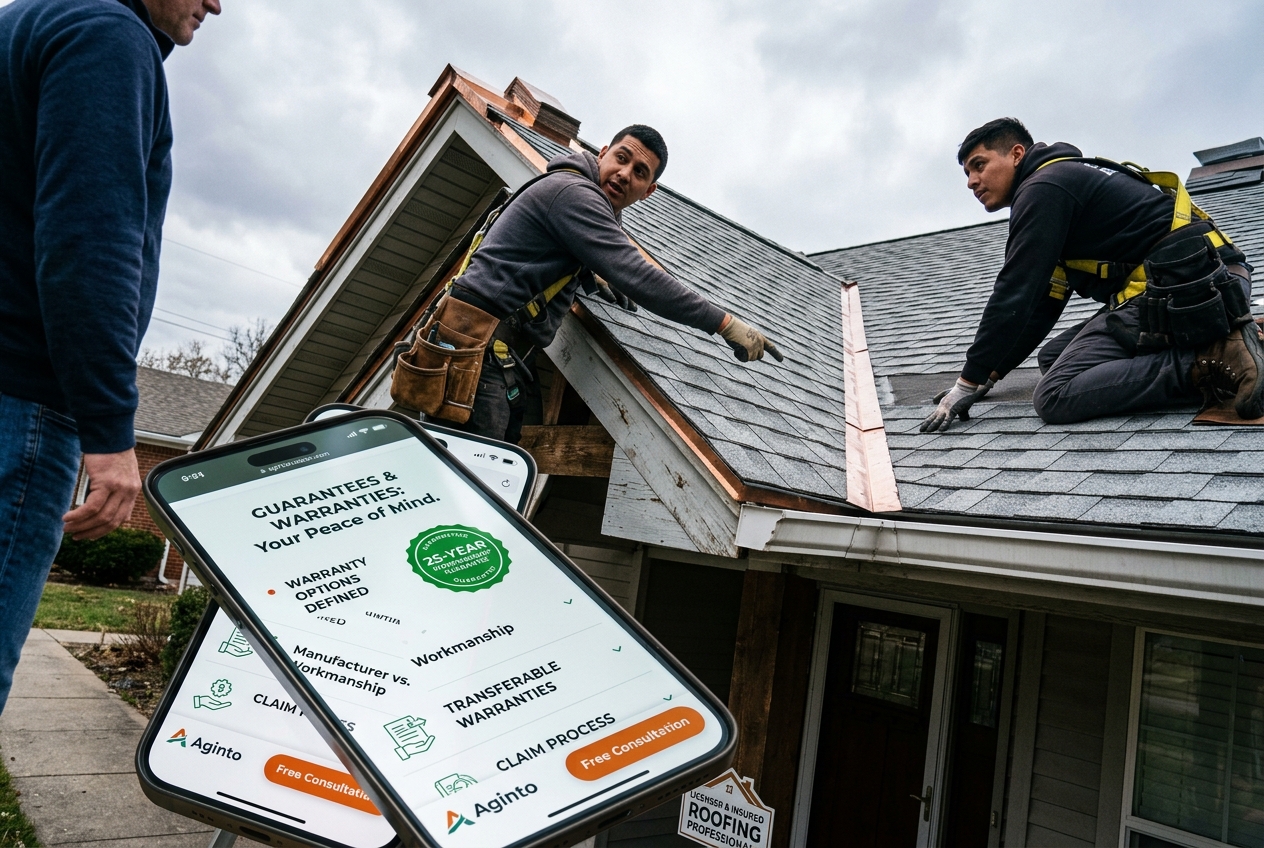
A dedicated page explaining your guarantees and warranties can quietly be one of your biggest differentiators. Most roofing companies bury this information — or skip it entirely.
A 2022 Consumer Insights report found that over 70% of consumers consider warranties an influential factor in their purchasing decisions. For a homeowner staring down a $15,000 roof replacement, knowing you stand behind your work can be the deciding factor between calling you or your competitor.
Be transparent. Explain the difference between a workmanship warranty — which covers the quality of your installation — and a manufacturer warranty, which covers the materials. Spell out the coverage periods. If your workmanship warranty is five years, say what it includes: Does it cover leaks from improper installation? Material failure? Are there exclusions?
For manufacturer warranties, mention the typical 10 to 30-year range and be specific about what’s covered and what isn’t. Some cover materials but not labor — and if you don’t say that clearly, customers will assume the worst when they eventually find out.
Real stories help here. If a previous customer had a section of their roof replaced at no cost under warranty, share that. It’s proof that your guarantee isn’t just marketing language.
Infographics or simple bullet-point breakdowns can make complex warranty terms easier to digest. Lead with the benefits — cost savings, long-term protection, peace of mind — rather than the fine print.
You might also reference industry benchmarks. The National Roofing Contractors Association publishes data on standard warranty practices, and showing that your coverage meets or exceeds those norms adds another layer of credibility.
Finally, include a short section on how to file a warranty claim. A clear, simple process removes the anxiety that often keeps people from feeling confident in a big purchase. If they know how to reach you when something goes wrong, they’re far more likely to say yes in the first place.
Structuring Content for Local Search Dominance
For roofing companies, local search isn’t just important — it’s where most of your customers are going to find you. A dedicated location page is one of the most effective ways to capture that traffic.
Start with a headline that includes the city or neighborhood and a key service term: “Roofing Services in [City]” tells both the visitor and the search engine exactly what the page is about. From there, weave in local keywords naturally — not just “roof repair” and “roof replacement,” but more specific phrases like “metal roofing in [City]” or “shingle repair near [Suburb]” that reflect how people in your area actually search.
Break the page into service sections — “Emergency Roof Repair in [City],” “Routine Roof Maintenance” — and tie each one to something locally relevant. If your area gets heavy rain in the fall, talk about how proper underlayment protects homes during that season. That kind of detail makes the content feel written for the reader, not for a search algorithm.
Local testimonials and case studies strengthen the page in two ways: they build trust with potential clients, and they naturally include the kinds of location-specific phrases that help with local rankings. A review that says “They replaced our roof in [Neighborhood] after the spring hailstorm” does more SEO work than most keyword strategies.
Embed a Google Maps widget. It ties the page to your Google Business Profile, adds an interactive element, and signals to search engines that you’re a real, located business serving a specific area.
If your company sponsors a local event, partners with a neighborhood hardware store, or participates in community home improvement programs, mention it. That content blends local relevance with genuine community presence — and it reads authentically because it is authentic.
Finally, optimize for mobile. A large share of local searches happen on phones, often from someone standing in their driveway looking up at a problem they just noticed. If your page is slow or hard to navigate on a phone, you’ve already lost them.
Frequently Asked Questions
What is the best way for roofers to get local leads?
The most reliable starting point is a fully optimized Google Business Profile — accurate information, current photos, and a steady stream of genuine customer reviews. Beyond that, SEO-driven blog content targeting your local area, involvement in community events, and referral relationships with other local businesses all contribute to a consistent flow of local leads.
Do roof inspection ads generate full replacement jobs?
Yes, when done right. Free or discounted inspection offers give homeowners a low-risk way to engage with your company. If the inspection reveals significant issues, and you’ve built trust through the process, converting to a full replacement becomes a natural next step — not a sales push. Honest, transparent assessments are what make that conversion happen.
How can roofers use social media to build trust?
Consistently. Before-and-after photos, maintenance tips, customer testimonials, and responses to comments all add up over time. Live Q&A sessions and participation in local community groups demonstrate both expertise and approachability. The goal isn’t to go viral — it’s to show up often enough that when someone in your area needs a roofer, your name is already familiar.
Raising the Next Roofline
Your services page, your warranty information, and your local SEO strategy don’t work in isolation. When they’re aligned — clear, credible, and easy to find — they create the kind of online experience that turns a casual visitor into a booked job.
If you’re not sure where to start, or you want a second set of eyes on what you’ve already built, contact Aginto for a free consultation. The path forward gets a lot clearer when you’re working with people who’ve done it before.

Most Roofing Companies Are Missing the Page That Actually Converts
Most roofing companies have a contact page, a services page, and maybe a few before-and-after photos. What they’re missing is the page that actually converts — and it’s costing them leads every single day.
If you’ve been wondering how roofing companies get leads online, the answer usually comes down to one thing: how well their website educates and builds trust before anyone picks up the phone. Your services page is the place where that happens — or doesn’t.
Creating a Services Page That Educates and Sells
A well-crafted services page is one of the most powerful tools a roofing company has online. It should do more than list what you offer — it should generate leads. Research from the Content Marketing Institute suggests that businesses with well-organized content see 30% more engagement, which translates into more inquiries and clients.
Start with clarity. Visitors should immediately understand what you do. Use straightforward headers like “Roof Repair,” “New Roof Installation,” and “Maintenance Services” — no jargon, no guesswork. Under each one, write a brief description that speaks directly to what the customer is dealing with, whether that’s a slow leak, storm damage, or an aging roof that’s past its prime.
Next, build credibility with trust signals. A study by the Edelman Trust Barometer found that 81% of consumers say brand trust is a deal-breaker in purchasing decisions. Testimonials that reference specific jobs — “They fixed a leak three other companies couldn’t find” — carry far more weight than generic five-star praise.
Don’t underestimate the value of helpful content, either. A short tip on spotting early signs of roof damage, or why fall inspections matter, positions you as the expert before a prospect ever calls. According to a B2B buyer survey by Demand Gen Report, 47% of buyers viewed three to five pieces of content before engaging with a salesperson. The more useful your page, the further along the buying journey you move them.
Make sure the page works on a phone. A survey by Blue Corona found that 57% of people wouldn’t recommend a business with a poorly designed mobile site. Fast load times and easy navigation aren’t optional anymore.
Visuals matter too. Before-and-after photos show your work without you having to say a word. Videos walking through a shingle replacement or metal roof installation keep visitors on the page longer — and according to EyeView Digital, that kind of content can increase conversion rates by 86%.
A services page that educates and sells isn’t about cramming in information. It’s about giving the right information, in the right order, in a way that makes someone feel confident enough to reach out.
Highlighting Guarantees and Warranty Options
A dedicated page explaining your guarantees and warranties can quietly be one of your biggest differentiators. Most roofing companies bury this information — or skip it entirely.
A 2022 Consumer Insights report found that over 70% of consumers consider warranties an influential factor in their purchasing decisions. For a homeowner staring down a $15,000 roof replacement, knowing you stand behind your work can be the deciding factor between calling you or your competitor.
Be transparent. Explain the difference between a workmanship warranty — which covers the quality of your installation — and a manufacturer warranty, which covers the materials. Spell out the coverage periods. If your workmanship warranty is five years, say what it includes: Does it cover leaks from improper installation? Material failure? Are there exclusions?
For manufacturer warranties, mention the typical 10 to 30-year range and be specific about what’s covered and what isn’t. Some cover materials but not labor — and if you don’t say that clearly, customers will assume the worst when they eventually find out.
Real stories help here. If a previous customer had a section of their roof replaced at no cost under warranty, share that. It’s proof that your guarantee isn’t just marketing language.
Infographics or simple bullet-point breakdowns can make complex warranty terms easier to digest. Lead with the benefits — cost savings, long-term protection, peace of mind — rather than the fine print.
You might also reference industry benchmarks. The National Roofing Contractors Association publishes data on standard warranty practices, and showing that your coverage meets or exceeds those norms adds another layer of credibility.
Finally, include a short section on how to file a warranty claim. A clear, simple process removes the anxiety that often keeps people from feeling confident in a big purchase. If they know how to reach you when something goes wrong, they’re far more likely to say yes in the first place.
Structuring Content for Local Search Dominance
For roofing companies, local search isn’t just important — it’s where most of your customers are going to find you. A dedicated location page is one of the most effective ways to capture that traffic.
Start with a headline that includes the city or neighborhood and a key service term: “Roofing Services in [City]” tells both the visitor and the search engine exactly what the page is about. From there, weave in local keywords naturally — not just “roof repair” and “roof replacement,” but more specific phrases like “metal roofing in [City]” or “shingle repair near [Suburb]” that reflect how people in your area actually search.
Break the page into service sections — “Emergency Roof Repair in [City],” “Routine Roof Maintenance” — and tie each one to something locally relevant. If your area gets heavy rain in the fall, talk about how proper underlayment protects homes during that season. That kind of detail makes the content feel written for the reader, not for a search algorithm.
Local testimonials and case studies strengthen the page in two ways: they build trust with potential clients, and they naturally include the kinds of location-specific phrases that help with local rankings. A review that says “They replaced our roof in [Neighborhood] after the spring hailstorm” does more SEO work than most keyword strategies.
Embed a Google Maps widget. It ties the page to your Google Business Profile, adds an interactive element, and signals to search engines that you’re a real, located business serving a specific area.
If your company sponsors a local event, partners with a neighborhood hardware store, or participates in community home improvement programs, mention it. That content blends local relevance with genuine community presence — and it reads authentically because it is authentic.
Finally, optimize for mobile. A large share of local searches happen on phones, often from someone standing in their driveway looking up at a problem they just noticed. If your page is slow or hard to navigate on a phone, you’ve already lost them.
Frequently Asked Questions
What is the best way for roofers to get local leads?
The most reliable starting point is a fully optimized Google Business Profile — accurate information, current photos, and a steady stream of genuine customer reviews. Beyond that, SEO-driven blog content targeting your local area, involvement in community events, and referral relationships with other local businesses all contribute to a consistent flow of local leads.
Do roof inspection ads generate full replacement jobs?
Yes, when done right. Free or discounted inspection offers give homeowners a low-risk way to engage with your company. If the inspection reveals significant issues, and you’ve built trust through the process, converting to a full replacement becomes a natural next step — not a sales push. Honest, transparent assessments are what make that conversion happen.
How can roofers use social media to build trust?
Consistently. Before-and-after photos, maintenance tips, customer testimonials, and responses to comments all add up over time. Live Q&A sessions and participation in local community groups demonstrate both expertise and approachability. The goal isn’t to go viral — it’s to show up often enough that when someone in your area needs a roofer, your name is already familiar.
Raising the Next Roofline
Your services page, your warranty information, and your local SEO strategy don’t work in isolation. When they’re aligned — clear, credible, and easy to find — they create the kind of online experience that turns a casual visitor into a booked job.
If you’re not sure where to start, or you want a second set of eyes on what you’ve already built, contact Aginto for a free consultation. The path forward gets a lot clearer when you’re working with people who’ve done it before.
Published on April 26, 2026

