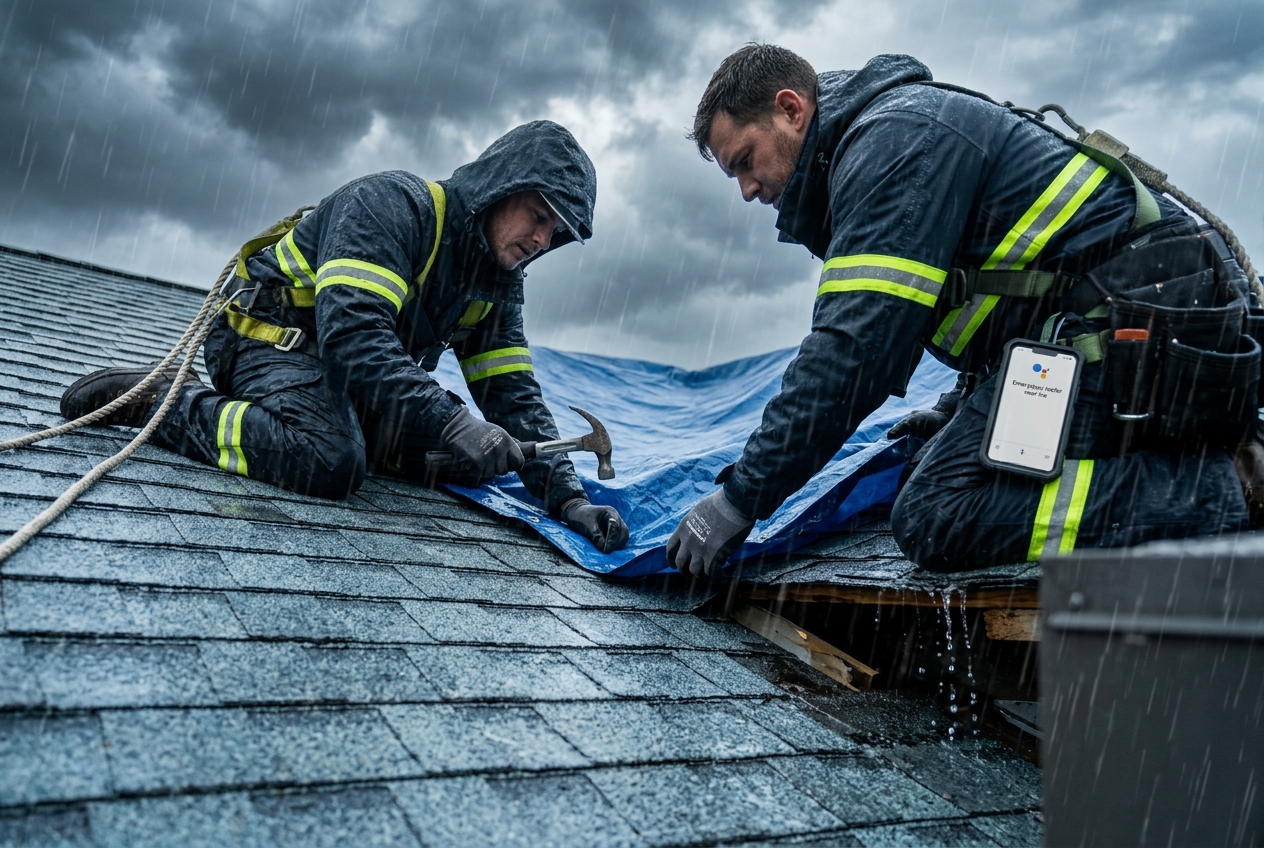

When a homeowner stands in the rain watching water pour through their ceiling, what do they actually do? They grab their phone and say, “Find an emergency roofer near me.” In that moment, they are not comparing five companies or reading long blog posts. They want one trustworthy answer, fast. Answer Engine Optimization, or AEO, is how your roofing company becomes that answer. It is the practice of structuring your content so voice assistants, AI summaries, and search engines pull your business straight to the top of an urgent query. For a foundation on the page that captures this kind of intent, see the one website page every roofing company is missing. This article breaks AEO down for emergency searches.
Optimizing for Urgent, Voice-Driven Queries
Figuring out how roofing companies get leads online increasingly means winning the spoken question, because emergency roofing searches are tailor-made for voice. When a roof is leaking, people do not type careful keywords; they talk to their phone in full sentences. Voice search has become a daily habit, and industry research reports that the majority of consumers prefer voice search to typing when they can, with billions of voice-enabled devices now in use through tools like Siri, Google Assistant, and Alexa. For roofers, that shift is a gift, because a voice search like “emergency roof repair near me” almost always comes from someone ready to hire immediately.
The catch is that voice results work differently from a screen full of blue links. A voice assistant usually reads back a single answer, so the goal is not page one; it is being the one result. To earn that spot, your content has to match how people actually speak. Write for natural, conversational phrasing rather than clipped keywords. Where a typed search might be “roof repair Tampa,” a spoken one is “Who can fix a roof leak in Tampa tonight?” Build pages and FAQ answers around those longer, question-shaped phrases.
Local signals carry enormous weight here. Voice queries lean heavily on “near me” intent, and the assistant pulls from local search data to decide who shows up. That means a complete, accurate Google Business Profile, consistent name, address, and phone details across the web, and genuine reviews are not optional, they are the engine behind voice visibility. Mention your specific service areas and neighborhoods in your content so the algorithm connects you to local intent.
Speed and mobile readiness matter too, since nearly every emergency voice search happens on a phone in a stressful moment. A page that loads instantly and puts a tap-to-call button front and center converts panic into a phone call. Create dedicated content for urgent scenarios, with clear headings like “Emergency Roof Repair” and direct, plain-language answers about response times and availability. When your site speaks the way worried homeowners speak and proves you are local and reachable right now, you position your company to win the searches that turn into same-day jobs.
Structuring Content to Appear in AI Summaries
Modern roofing contractor marketing strategies have to account for a new gatekeeper: the AI-generated summary that now sits above traditional search results. When someone searches a roofing question, Google increasingly answers it directly with an AI Overview, pulling sentences from sites it trusts. If your content is the source, you earn visibility and authority before a competitor’s link is ever seen. If it is not, you may be buried beneath an answer drawn from someone else.
These AI features command attention. Research on search behavior shows just how much traffic these answers absorb. A widely cited analysis of zero-click search found that well over half of Google searches now end without a single click to an outside website, as AI Overviews and answer boxes satisfy the query on the spot. As AI Overviews expand, being the quoted source is becoming as valuable as ranking first once was. The roofers who structure content to be quotable win that placement.
Writing for AI summaries follows a clear pattern. Lead with the answer. When you address a question like “How fast can you tarp a leaking roof?” give the direct response in the first sentence, then expand with detail underneath. AI engines favor content that answers cleanly and immediately. Use plain language, short paragraphs, and descriptive headings that mirror real questions, because these are the passages engines lift most easily.
Organize information so a machine can parse it. Break services into clearly labeled sections, use bullet points for steps or options, and keep each answer self-contained so it makes sense out of context. A well-built FAQ section is especially powerful, since each question-and-answer pair is exactly the bite-sized, authoritative format AI summaries reward.
Credibility still decides who gets quoted. Back claims with specifics, reference your real experience and local knowledge, and keep information accurate and current, because engines favor sources they can trust on a high-stakes topic like protecting a home. Cite warranty norms, response times, and material details that prove expertise. When your content answers urgent roofing questions in a direct, structured, trustworthy way, it becomes the material AI engines pull from, putting your company in front of homeowners at the exact moment they need a roofer.
Using Schema Markup to Capture Quick Answers
The best SEO practices for roofing businesses now include a piece of behind-the-scenes code that most competitors ignore: schema markup. Schema is structured data you add to your website that tells search engines exactly what your content means, not just what it says. It labels your business name, services, hours, location, reviews, and FAQ answers in a language search engines read perfectly, which makes your site far more likely to surface in rich results, voice answers, and AI summaries.
This is where AEO gets technical, but the payoff is concrete. Schema is an open standard backed by Google, Microsoft, Yahoo, and Yandex through Schema.org, and the search engines themselves recommend it for helping their systems understand and feature your pages. When you mark up an FAQ answer about emergency roof repair, you make it easy for an assistant to read that answer aloud or for an AI Overview to quote it. Without schema, you are leaving that interpretation to chance.
Start with the markup that matters most for roofers. LocalBusiness schema tells engines you are a real, located company serving a specific area, reinforcing the “near me” signals that drive emergency searches. Service schema spells out exactly what you offer, from storm-damage repair to full replacement. FAQ schema attaches structured tags to your question-and-answer content so it qualifies for rich, quotable placements. Review schema can surface your star rating directly in results, which builds instant trust for a panicked homeowner scanning their phone.
Add markup for the details that win urgent jobs: your hours, including whether you offer 24/7 emergency service, your phone number, and your service areas. The more precisely you label this information, the easier it is for an engine to confidently present you as the answer to a “right now” query.
You do not need to hand-code everything; plugins and structured-data tools can generate clean markup, and Google’s Rich Results Test confirms it is working. The key is to implement it correctly and keep it current, since outdated hours or wrong contact details do more harm than no markup at all. When your site speaks search engines’ native language through schema, you give your content the best possible chance to be the quick answer a roofing emergency demands.
Frequently Asked Questions
What is the best way for roofers to get local leads?
Begin with a fully optimized Google Business Profile, accurate and consistent contact details across the web, and a steady stream of genuine reviews. Layer in AEO: conversational, question-based content, local service-area pages, schema markup, and a fast, mobile site with tap-to-call. Together these capture the urgent “near me” and voice searches that turn into same-day roofing jobs.
Do roof inspection ads generate full replacement jobs?
Yes, when handled honestly. A free or low-cost inspection gives homeowners a low-risk reason to engage. If the inspection reveals real problems and you have built trust through a transparent assessment, moving to a full replacement becomes a natural next step rather than a hard sell. Clear, fair reporting is what converts inspections into larger jobs.
How can roofers use social media to build trust?
Show up consistently with before-and-after photos, maintenance tips, customer testimonials, and quick replies to comments and questions. Live Q&A sessions and participation in local community groups demonstrate both expertise and approachability. The aim is not to go viral but to stay familiar, so when someone nearby needs a roofer, your name is already the one they recognize.
Raising the Next Roofline
AEO is how roofing companies meet homeowners at their most urgent moment, when a leak sends them reaching for their phone and asking for help out loud. Optimizing for voice queries, structuring content for AI summaries, and adding schema markup work together to make your business the answer that gets read back and the link that gets the call. If you want help putting these pieces in place, contact Aginto for a free consultation and let our team build an AEO and roofing marketing strategy around your goals.